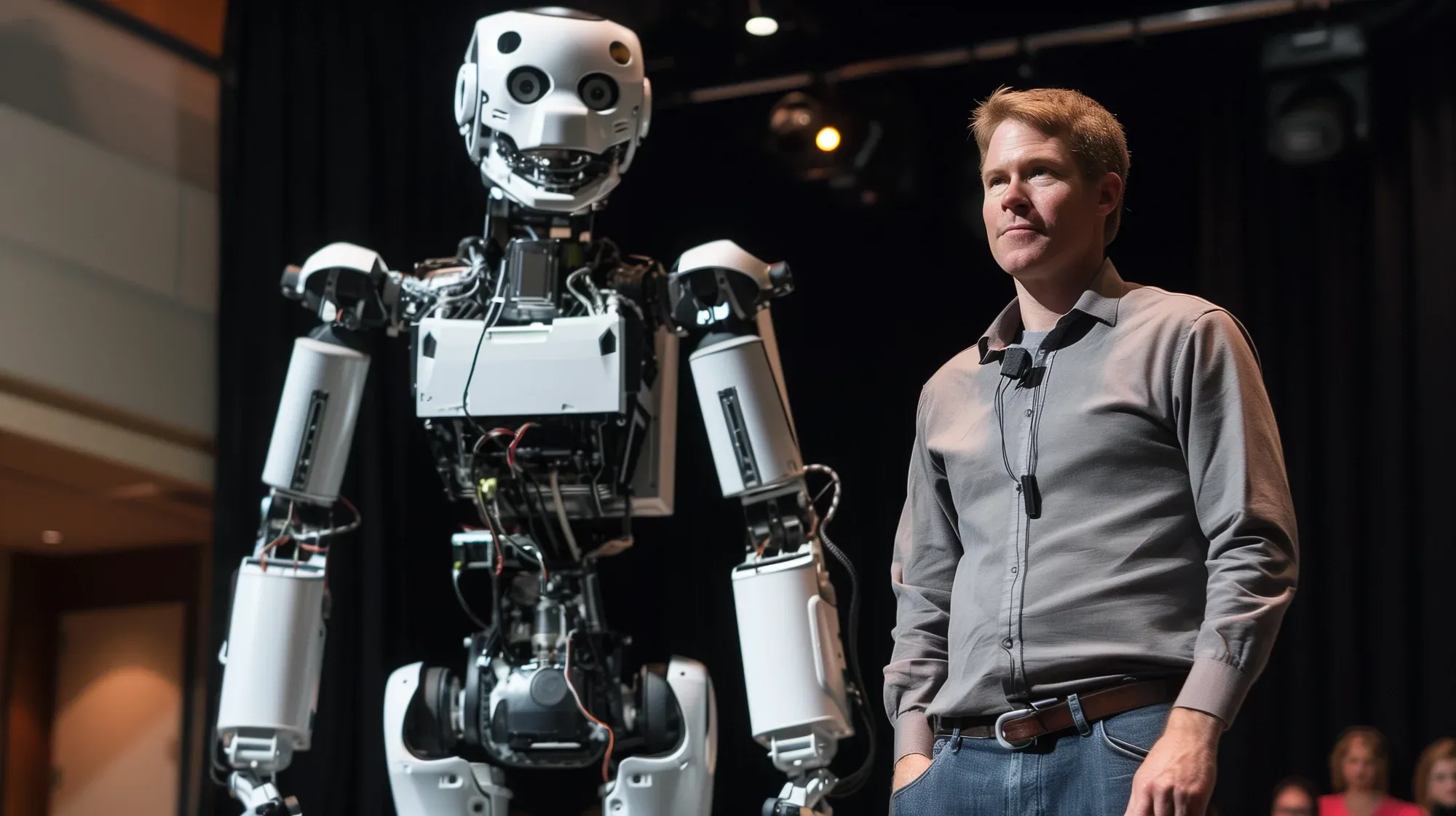
The Ontology of Automation: Identity in the Age of Inference
As AI erodes the economic value of execution, we must architect a new framework for professional self-worth.
It begins with a blinking cursor, followed by a stream of tokens that renders years of your professional discipline obsolete in seconds.
For the senior software engineer, it is the moment an LLM generates a complex, bug-free refactoring plan for a legacy codebase they spent a decade mastering. For the corporate strategist, it is seeing a machine hallucinate—then correct—a market analysis that would have taken a team of junior associates a week to compile. The feeling is not merely professional anxiety; it is a distinct, visceral form of ontological shock. It is the sudden, chilling realization that the cognitive friction you once sold as "expertise" has been reduced to a compute cost.
We are living through the collapse of the Execution Economy. For the last two centuries, economic value was derived primarily from the ability to execute tasks: to calculate, to write, to code, to design, to assemble. Our professional identities were forged in the fires of this utility. We answered the question "Who are you?" with "What do you do?" because the doing was the difficult part. Proficiency was a proxy for character, and output was the metric of self-worth.
The Decoupling of Utility and Identity
The rise of generative AI precipitates a crisis that is fundamentally different from previous technological disruptions. The loom replaced muscle; the calculator replaced mental arithmetic. But Large Language Models and agentic workflows are replacing judgment and synthesis—the very faculties we deemed exclusively human.
As AI erodes the economic premium on execution, we face a profound identity crisis. If the market value of your output approaches zero, does the value of your professional self follow suit? If we cling to the old equation—where Self-Worth = Economic Utility—we are setting ourselves up for a collective psychological collapse. We are witnessing the birth of the Intent Economy, a paradigm where value shifts upstream from the how of production to the why of direction.
Architecting a New Ontology
This is not merely a labor market adjustment; it is a philosophical imperative. We must architect a new framework for professional existence that decouples human dignity from computational output. The "Ontology of Automation" suggests that as the machine takes over the domain of answers, the human domain becomes purely one of questions.
In this new era, the "expert" is no longer the repository of knowledge, but the architect of inquiry. The value lies not in the ability to write the code (STACKS), but in the wisdom to know what needs to be built (SOLUTIONS). It lies in understanding the underlying frameworks of value (SCHEMAS) rather than the mechanics of capture.
We must redefine professional identity not by what we can produce, but by what we can envision. The future belongs to those who can navigate this shift from being the engine of execution to becoming the governor of intent. As we explore the depths of this transition, we will rely on the theoretical underpinnings found in our SCHEMAS column to map the territory, while looking to SIGNALS to understand the velocity of this change.
The machine is here to do the work. We must figure out who we are when the work is done.
Historical Echoes: From Loom to LLM
When the stocking frames of the early 19th century began to rattle through Nottinghamshire, the Luddites did not smash them out of ignorance, but out of a precise understanding of economic obsolescence. They recognized that the machinery did not merely automate weaving; it decoupled the value of the textile from the artisan's lifetime of honed motor skills. The Industrial Revolution was a crisis of execution—it replaced human muscle and dexterity with steam and gears.
For the subsequent two centuries, the social contract was rewritten around a clear dichotomy: machines handle the physical drudgery, while humans claim the cognitive high ground. Peter Drucker’s coining of the "knowledge worker" in 1959 formalized this retreat into the mind. We built entire educational hierarchies and economic SCHEMAS on the premise that abstraction was our fortress. As long as one could manipulate symbols, synthesize data, and make complex decisions, one was immune to the mechanization that had hollowed out the factory floor.
That immunity has proven to be a temporary historical artifact.
The AI revolution is not an extension of the industrial logic; it is an inversion of it. Where the steam engine devalued caloric output, the Large Language Model devalues inference. We are witnessing the industrialization of cognition itself. The error of the modern professional class was assuming that activities like coding, legal analysis, and financial modeling were creative acts of pure agency. In reality, much of this work—perhaps 80% of it—is sophisticated pattern matching. It is probabilistic, not deterministic, and therefore perfectly suited for the stochastic engines of generative AI.
This collapse of the "cognitive safe harbor" is psychologically more devastating than the displacement of the 19th century. When a machine lifts a heavy beam, the construction worker does not feel their humanity diminished; their value is merely shifted. But when a STACKS analysis tool refactors a sprawling codebase in seconds—a task that would have defined a senior engineer’s contribution for a month—it attacks the core of their professional identity. The skill is no longer scarce, and thus, strictly speaking, no longer economically distinct.
The knowledge worker’s assumption of safety relied on the belief that context and nuance were computationally irreducible. We believed that writing a compelling marketing strategy or diagnosing a rare systemic bug required a "spark" that silicon couldn't replicate. We were wrong. It turns out that nuance is just high-dimensional data, and context is just a very long token window.
As we analyze in our SOLUTIONS column, this shift demands a radical re-evaluation of business administration. We are moving from an era where value was generated by processing information to an era where value is generated by curating the output of infinite processing power. The loom replaced the weaver's hands; the LLM is replacing the analyst's cortex. The question we must now face, as the economic premium on "smart" evaporates, is simple yet terrifying: If you are not your output, then who are you?
The Engineer's Dilemma: A Case Study in Obsolescence
If the Luddites fought the decoupling of skill from execution in the physical realm, the modern software engineer faces a more abstract, yet equally existential, decoupling in the cognitive realm. For decades, the ability to write code—to speak the machine’s language—was the ultimate leverage. It was the "hard skill" par excellence, a moat dug with thousands of hours of syntax memorization, algorithmic drilling, and system debugging. The software engineer was the artisan of the information age, their value seemingly protected by the sheer complexity of their craft.
However, the rapid ascent of Large Language Models (LLMs) and generative coding assistants has pierced this veil of exceptionalism. We are witnessing a phenomenon where the economic value of execution approaches zero. When an AI can scaffold a microservice architecture, write unit tests, and refactor legacy code in seconds, the human engineer's proficiency in these tasks ceases to be a differentiator. It becomes, instead, a commodity.
The Grief of the Deprecated API
This transition precipitates a specific professional grief. The engineer’s identity is often forged in the fires of difficulty; the pride of the profession is inextricably linked to the struggle of mastery. There is a "Sunk Cost Fallacy of Expertise" at play here. A senior developer who spent a decade mastering the intricacies of memory management in C++ or the reactive patterns of modern JavaScript frameworks may view AI code generation not as a tool, but as an insult. The resistance to these tools—often framed as concerns over code quality or security, though valid—frequently masks a deeper psychological rejection: If the machine can do what I do, does my struggle matter?
We see this played out in the commit logs and pull requests of enterprise repositories. The friction is palpable. It is the friction of professionals realizing that their "hard skills" are becoming "soft" in real-time. The ability to recall the parameters of a specific library function is no longer a badge of honor; it is trivia. The value shifts violently from the how (implementation) to the what (specification) and the why (architecture).
From Builder to Verifier
This shift demands a re-architecture of professional self-worth. In the STACKS column, we often discuss the technical merits of new frameworks, but here, under the lens of SCHEMAS, we must analyze the framework of the worker themselves. The engineer must evolve from a builder—one who lays bricks of logic—to an architect and a verifier. The new competency is not in writing the code, but in judging the truth and utility of the code the system provides.
This is a crisis of identity because it forces the technical expert to adopt the posture of a manager—a role many engineers explicitly rejected. Yet, the data is clear: the productivity gains from AI-augmented development are too significant for the market to ignore. The engineer who clings to the manual execution of syntax will find themselves in the same economic position as the hand-weaver in 1820: proud, skilled, and increasingly irrelevant.
As we navigate this transition, we must look beyond the immediate loss of execution value. We must identify what remains when the syntax is stripped away. The answer lies not in the code itself, but in the intent behind it.
For further analysis on the economic implications of this shift, see our upcoming SCHEMAS dispatch on "The Economics of Zero-Marginal Cost Creation."
The Psychology of Resistance
If the decoupling of skill from execution creates an economic crisis, the decoupling of identity from output creates a psychological one. The resistance we see to AI adoption in high-skill sectors is rarely just about job security; it is a defense mechanism against a deeper existential threat. In psychology, this is explained by the concept of Identity Fusion. For many knowledge workers—developers, writers, analysts—the boundary between the "personal self" and the "professional self" has become porous to the point of non-existence. When who you are is strictly defined by what you produce, the automation of production feels less like efficiency and more like erasure.
This fusion makes the introduction of LLMs into workflows feel distinctively personal. It triggers a specific variant of Imposter Syndrome, amplified by speed. Previously, Imposter Syndrome was the fear that one’s internal competence didn’t match external perception. Today, it is the fear that one’s internal competence is objectively obsolete. When a senior engineer sees an AI solve a race condition in seconds—a problem that might have previously justified a week of their salary—the reaction is often a retreat into what we might call "The Niche of Inefficiency."
We observe this in the tendency of professionals to double down on tasks that are currently resistant to automation, regardless of their economic value. A developer might obsess over manual memory management in a context where a garbage-collected language (and AI-generated boilerplate) would suffice. A marketer might reject AI-generated copy not because it is ineffective, but because the act of writing the draft is the work they recognize as valuable. This is productive procrastination on an industrial scale: retreating into the unscalable to feel indispensable.
This behavior aligns with observations in our SCHEMAS column regarding "perceived effort valuation." We value our output based on the struggle required to produce it. When the struggle is removed, the value proposition collapses internally, even if the market value of the final product remains unchanged. The resistance is not a refusal to use the tool; it is a refusal to accept that the "hard things" were merely obstacles, not virtues.
Furthermore, this psychological friction creates organizational drag. While SOLUTIONS case studies often highlight efficiency gains, they frequently gloss over the "adoption valley of death"—the period where productivity dips because the humans in the loop are subconsciously sabotaging the tools that threaten their self-concept. They find edge cases where the AI fails and hold them up as proof of total incompetence, a phenomenon known as "automation bias reversal." It is a desperate attempt to prove that the human "magic" is still required in the loop.
As we move forward, we must recognize that overcoming this resistance requires more than just upskilling (the domain of STACKS); it requires "re-selfing." We need to construct a professional identity that is antifragile to inference—one that derives value not from the execution of the task, but from the curation of the problem.
This necessitates a shift from the Operator Mindset to the Architect Mindset, a transition that fundamentally alters the ontology of work itself.
The 'Liminal Gap': Operationalizing Idle Time
If resistance is the psychological byproduct of lost execution, the "Liminal Gap" is the operational reality where that loss occurs. The source text identifies this gap as the temporal space between issuing a prompt and receiving the inference—the "waiting room" of the modern workflow. In traditional labor economics, this latency is waste. In the age of inference, however, this gap represents the single most valuable asset a knowledge worker possesses. It is not a pause; it is a pivot point.
To survive the ontological shift, we must reframe this idle time not as a passive wait for a product, but as an active period of high-level simulation. While the model handles the deterministic collapse of probability (generating the token or the function), the operator must engage in non-deterministic strategy. We call this the Active Inference Protocol.
From Linear Execution to Parallel Strategy
The error most professionals make during the "gap" is treating it as a micro-break. This forfeits agency. Instead, this time must be operationalized to perform tasks that the AI cannot purely derive from its training data—specifically, tasks requiring spatial awareness of the project's unique constraints and temporal awareness of its long-term goals.
We propose a three-stage methodology to colonize this gap:
- Contextual Interferometry (The "Where"): While the AI generates a specific module or paragraph, the operator must mentally simulate its integration into the broader system. Does the code being generated conflict with the architectural patterns established in the legacy repo? Does the argument being drafted contradict the tone set in the introduction? By simulating the integration before the generation is complete, the operator prepares to act as an immediate filter, reducing the "context drift" that plagues long-context LLM interactions.
- Adversarial Auditing (The "What If"): The model optimizes for probability; the human must optimize for edge cases. During the gap, the operator should be formulating tests to break the output. In software engineering, this means writing the unit test before the function returns. In analysis, it means identifying the counter-argument that the AI’s consensus-driven weights will likely ignore. This shifts the human role from "creator" to "rigorous critic," a stance that preserves high-status expertise even without manual execution.
- Teleological Alignment (The "Why"): Execution is seductive; it feels like progress even when it is merely motion. The pause forced by AI generation provides a mandatory "strategic check-in." Is this prompt actually solving the root problem, or is it merely patching a symptom? The gap is the only moment in the workflow where the operator can step back from the weeds to verify the trajectory.
The Economic Consequence
By mastering the Liminal Gap, the professional transitions from being paid for throughput (words written, lines coded) to being paid for latency reduction (how quickly a correct, safe, and strategic solution is converged upon). This is the domain of our SCHEMAS column, where we explore the theoretical frameworks necessary to navigate these economic inversions.
As we move away from the dopamine loop of direct creation, the "Identity Fusion" discussed previously must re-anchor itself here: not in the act of typing, but in the act of orchestrating. The gap is where the architect lives. The machine lays the bricks; you verify the blueprint.
This operational shift, however, exposes a new fragility. If our value is no longer in the how but in the why and where, our educational and professional development systems—which are almost entirely focused on execution—are woefully obsolete. We are training bricklayers for a world that needs only architects.
The Intent Economy: From Doing to Directing
The fundamental axiom of the industrial and early information ages was that execution equaled value. The capability to lay bricks, write code, or draft legal briefs was the primary constraint on production. Consequently, professional identity—and compensation—was calibrated to the proficiency of these outputs. We are now witnessing the inversion of this economic law. As Large Language Models (LLMs) and diffusion models drive the marginal cost of execution asymptotically toward zero, the economic premium is migrating aggressively from the how to the what and the why. We are entering the Intent Economy.
In this new paradigm, the bottleneck is no longer the ability to manifest an idea, but the quality of the volition behind it. When a system can generate infinite variations of a marketing campaign or a software feature in seconds, the act of creation is commoditized. Value is captured not by the builder, but by the architect who can articulate a precise vision and the editor who can distinguish the signal from the noise.
The Scarcity of Volition
Volition—the specific, directed will to bring a particular reality into existence—is becoming the rarest resource in the enterprise. In a friction-free creation environment, the danger is not "writer's block" but "writer's flood." Without strong, specific intent, AI generates mediocrity at scale.
The high-value worker of the next decade is an Intent Engineer. This is not merely about "prompting"; it is about maintaining a coherent strategic narrative across thousands of inferential cycles. It requires a cognitive shift from procedural generation (knowing the steps) to declarative specification (knowing the desired state). As detailed in our SCHEMAS column analysis of cognitive labor, this moves the professional focus from the syntax of the work to the semantics of the outcome.
Taste as an Operational Imperative
If volition is the input, taste is the necessary filter for the output. In the Intent Economy, taste is not a subjective artistic preference but an objective economic function. It is the ability to look at ten probabilistic outputs and instantly identify which one aligns with the strategic intent, brand voice, and user need.
Previously, a senior engineer might have spent 80% of their time coding and 20% reviewing. That ratio is flipping. The primary value add is now the rigorous heuristic evaluation of AI-generated artifacts. This requires a depth of domain expertise that cannot be automated; one cannot effectively direct an orchestra without deeply understanding music theory, even if one no longer plays the violin.
The Rise of the Conductor
This transition forces a reimagining of the professional archetype: the shift from the Builder to the Conductor. The Builder derives satisfaction and identity from the friction of the material—the struggle with the compiler, the crafting of the sentence. The Conductor derives value from the unification of disparate elements into a cohesive whole.
This is a traumatic shift for many. It requires relinquishing the "craftsman" identity, often linked to the specific tools of the trade (the IDE, the canvas), in favor of a "director" identity linked to outcomes. However, for those who bridge this psychological gap, the leverage is unprecedented. A single individual with high volition and impeccable taste can now output the volume of a traditional department.
As we dissect in the SOLUTIONS vertical regarding management science, organizations must restructure to accommodate these "10x Conductors." The hierarchy of the future is flatter, composed of sovereign individuals wielding massive inferential compute, bound together not by management layers, but by shared protocols of intent.
This re-architecture of value demands we look closely at the specific mechanisms of this new leverage. How does one actually manage a workforce of probabilistic agents? The answer lies in the emerging stack of agentic orchestration.
A New Schema for Professional Identity
The prevailing career metaphor of the last two decades has been the "T-shaped" professional: possessed of deep, vertical expertise in a single domain (the stem) and broad, horizontal knowledge across adjacent fields (the bar). This geometry of value is collapsing. When AI agents can simulate PhD-level expertise in vertical domains—from writing Python scripts to diagnosing radiology scans—the economic moat of "depth" evaporates. We must abandon the industrial architecture of the specialist and adopt a new topology: the Portfolio Self.
In the SCHEMAS column at XPS, we analyze how economic frameworks dissolve under technological pressure. The Portfolio Self is not defined by a static capability ("I write code") but by dynamic synthesis ("I architect solutions"). If the cost of execution approaches zero, the value of decision approaches infinity. In this new ontology, professional identity must be rebuilt around four pillars where human "inefficiency" is a protective feature, not a bug to be optimized away.
1. Synthesis Over Generation
The generative era paradoxically devalues generation. When a model can produce a thousand marketing copy variations in seconds, the writer’s value shifts from drafting to curation. The Portfolio Self thrives on Synthesis: the ability to recognize patterns across uncorrelated datasets. It is the distinct human capacity to bridge a STACKS insight about compiler logic with a SOLUTIONS insight about organizational behavior to create a novel business model. We are moving from being creators of artifacts to curators of inference.
2. Strategic Ambiguity
Algorithms require specific objective functions to optimize. They struggle with the undefined, the paradoxical, and the absurd. Human value now resides in Strategic Ambiguity—the ability to navigate situations where the "correct" answer is culturally relative or ethically grey. While an AI can optimize a supply chain for efficiency, only a human can decide when efficiency should be sacrificed for resilience or community trust. This is the realm of "slow thinking," where the latency of biological cognition allows for moral weighting that instant inference cannot replicate.
3. Relational Capital as Currency
In an ecosystem flooded with synthetic media and automated outreach, trust becomes the scarcest resource. The "signal-to-noise" ratio in professional communication is plummeting. Consequently, the Portfolio Self prioritizes Relational Capital. Identity is anchored in who trusts you, not just what you know. We are seeing a return to high-friction, high-trust interactions—handshakes, dinners, and unrecorded conversations—as the only unforgeable proofs of work.
4. The Curator of Intent
Finally, we must transition from being "operators of tools" to "directors of intent." The T-shaped employee asks, "How do I do this task?" The Portfolio Self asks, "Why does this task exist?" This shift requires a philosophical reorientation, treating one's career not as a ladder of accumulating skills, but as a portfolio of directed outcomes.
As we strip away the execution layer of our jobs, we are left with the uncomfortable but liberating question of purpose. The Portfolio Self is an active investor in its own agency. It does not wait for a ticket to be assigned; it defines the scope of the project.
Explore further frameworks for the post-labor economy in our SCHEMAS column, or review the technical implications of agentic workflows in STACKS.
Conclusion: The Human Remainder
The disaggregation of the "job" from the "work" is the defining economic schism of our decade. For the better part of a century, professional identity has been forged in the fires of execution: we were valued for how cleanly we wrote code, how precisely we drafted legal briefs, or how efficiently we managed logistical chains. We equated our worth with our ability to process information and produce specific, tangible outputs. But as large language models and agentic systems drive the marginal cost of this high-fidelity execution toward zero, that equation has broken. The "T-shaped" professional is being deprecated not by a lack of skill, but by the commoditization of the skills they once sold at a premium.
This is not an obsolescence event; it is a distillation event.
When the machine takes the job—the structured, repetitive, and technically demanding act of execution—the human is left with the work. The work is the messy, undefined, and often chaotic origin point of value. It is the ability to perceive a market inefficiency before it has a name; the capacity to empathize with a user’s frustration before it becomes data; the judgment to decide which software to build, not just the proficiency to build it.
We are entering an era where the primary bottleneck is no longer the "how" (technical implementation) but the "what" and the "why" (strategic intent). In this new ontology, the human element is not the slow component to be optimized away; it is the governing constant. The value of a professional will no longer be measured by their output volume, but by the "semantic density" of their inputs—the quality of the instructions, constraints, and ethical boundaries they provide to their synthetic counterparts.
We must become architects of intelligence rather than bricklayers of code. This requires a profound psychological pivot. We have to decouple our ego from the act of creation and reattach it to the act of curation. The "Human Remainder" is that which cannot be inferred from training data: novelty, distinctiveness, and the audacious pursuit of problems that do not yet have solutions. The machine can predict the next token, but it cannot predict the next paradigm. That remains the province of the human mind.
As we shed the robotic aspects of our careers—the rote memorization of syntax, the manual compilation of reports—we are freed to ascend the abstraction ladder. We are liberated to focus on system design, cross-domain synthesis, and the nuanced dynamics of human relationships. This is a daunting transition, as it strips away the comfortable friction that once filled our 9-to-5 days, exposing us to the raw, existential weight of pure decision-making. Yet, it is also the ultimate opportunity to reclaim the creative agency that industrialization long ago subsumed.
Charting the Transition
The theory of this transformation is clear, but the mechanics of navigating it are complex. How does one practically restructure a workflow when the "intern" is an infinite-context LLM? How do organizations redesign org charts when singular individuals can command the output of entire departments?
To answer these questions, we must move from the philosophical to the tactical. We invite you to explore the SOLUTIONS column, where we deconstruct the specific architectures of AI-augmented entrepreneurship. There, you will find practical guides on implementing agentic workflows, redesigning operational stacks, and managing the delicate interface between biological intent and silicon execution. The future is not waiting to be written; it is waiting to be prompted.
This article is part of XPS Institute's Schemas column.